Services
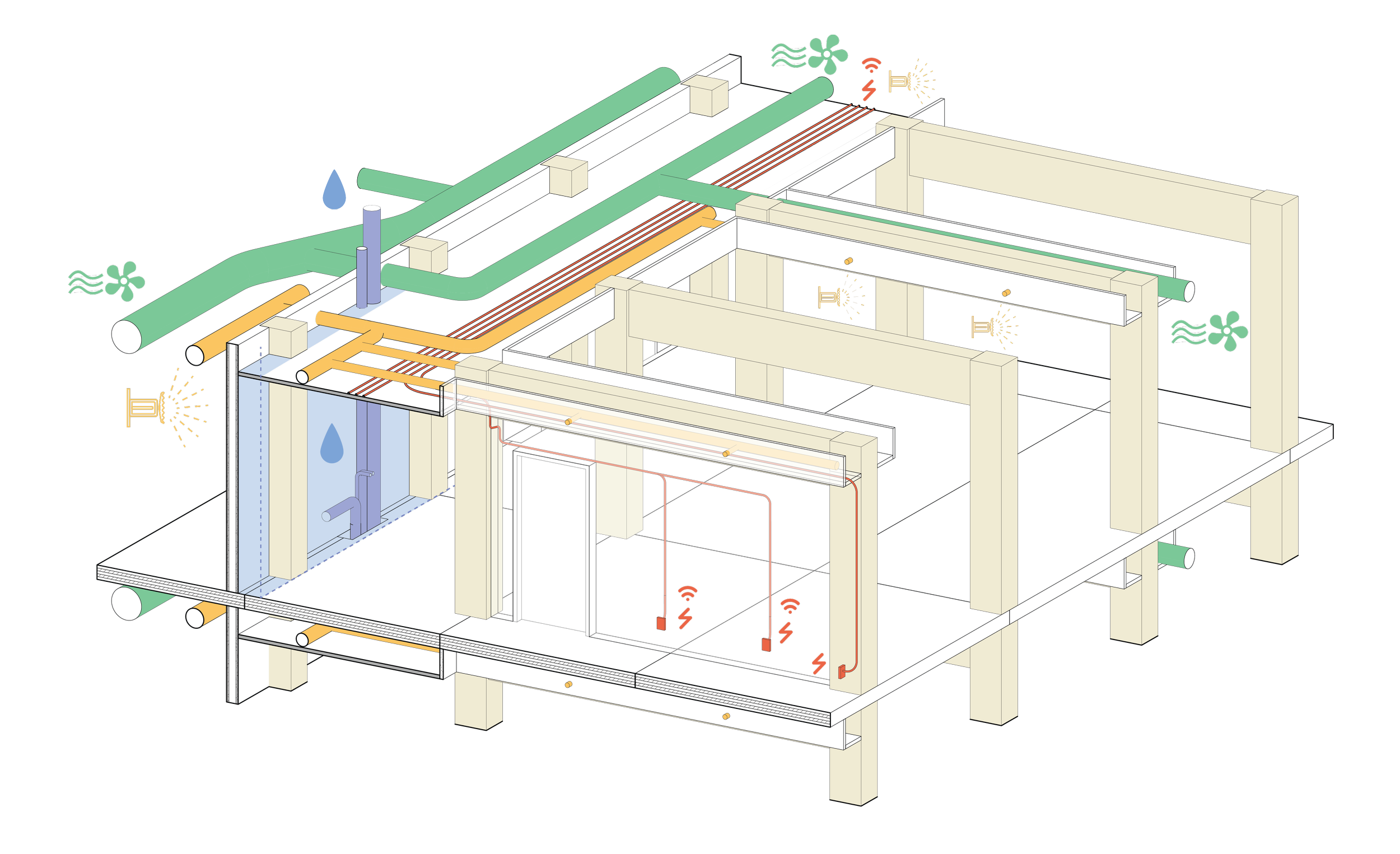
Coordinated systems that enable flexibility.
In most housing systems, building services are a hidden driver of rigidity.
In this system, services are treated differently.
They are pre-coordinated, organized clearly, and embedded within the modular logic—supporting variation, repeatability, and long-term adaptability rather than reinforcing rigidity.
Why Services Matter
in a Modular System
A rationalized and repeatable services layout supports flexible unit configurations—without increasing risk, cost, or coordination effort.
Objectives:
In this research project, services coordination was treated as a primary design driver, not a downstream problem to be resolved after planning decisions were made. Our objective was to organize building services in a way that preserves planning freedom, supports prefabrication, and enables long-term adaptability—while remaining compatible with real-world construction and regulatory constraints. This approach focused on three key principles:
Pre-Fabricated
Predictable service zones
Prefabrication scales only when services are organized for repetition. In many systems, service routing requires project-specific coordination with structure—particularly penetrations through mass timber elements—limiting repeatability.
Here, services are contained within defined service zones, with penetrations occurring in predictable locations. This reduces conflict with structure and supports consistent, off-site fabrication.
Flexible & Adaptable
Preserving planning freedom
Building services are often a hidden source of rigidity. Once distribution paths are fixed, unit layouts become difficult to change.
By organizing services as clear, repeatable layers—kept separate from primary living spaces—this system preserves planning freedom. Units can be reconfigured or adapted without reworking core service infrastructure.
Pre-Engineered
Reducing complexity to enable scale
Modular housing is often constrained not by structure, but by the complexity of services coordination.
Pre-engineering service integration resolves this early. By defining service layouts, zones, and interfaces in advance, the system reduces coordination effort and supports faster, more scalable project delivery—allowing teams to focus on the quality and livability of space.
Operational Benefits
A coordinated services strategy delivers value beyond construction
By consolidating distribution, shortening service runs, and standardizing access points, the system supports:
Simplified commissioning and maintenance
Clear service access for upgrades and repairs
Reduced disruption to living spaces over time
These operational benefits are a direct result of treating services as part of the system architecture rather than as isolated technical components.
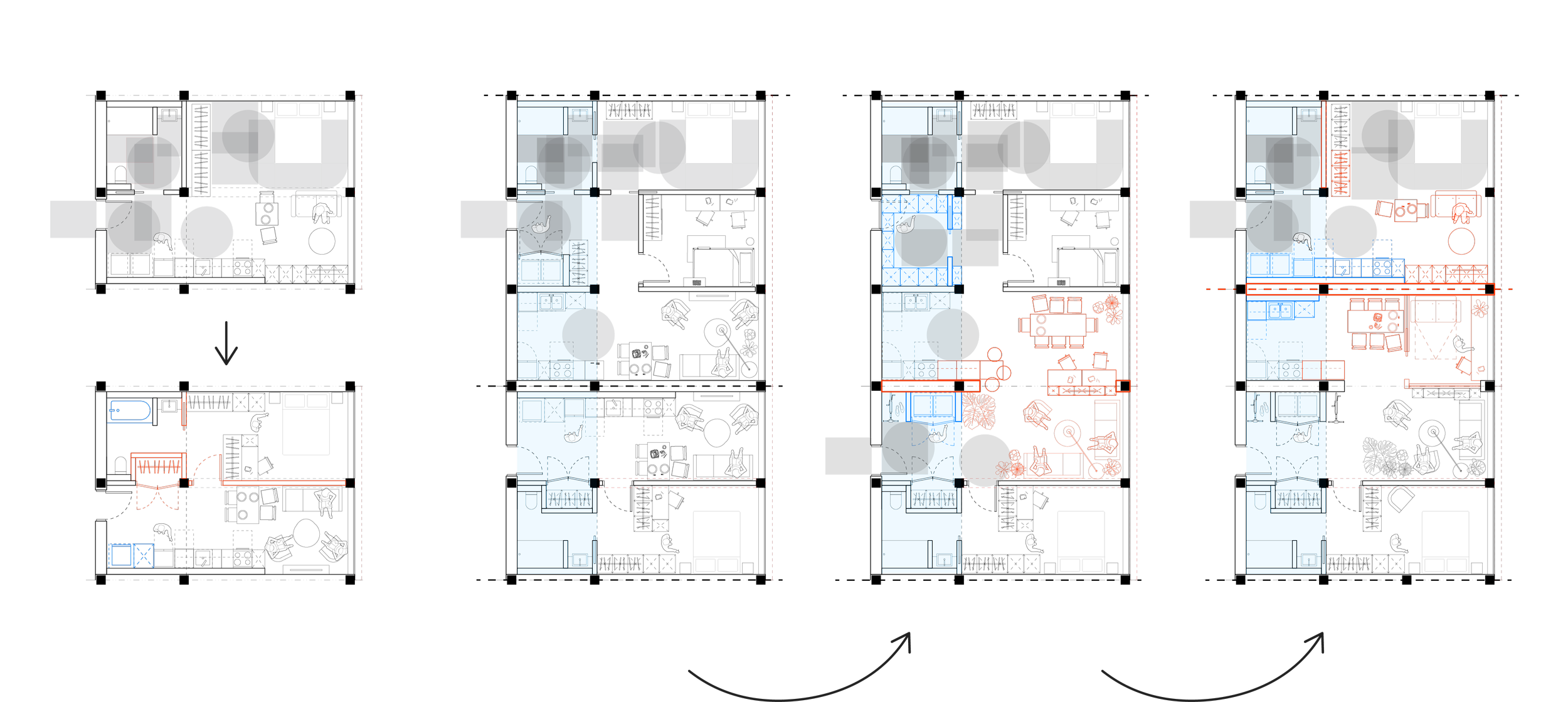
Housing that Grows with You
The result is housing that is not locked into a single moment in time.
Clear service organization allows units to adapt as household needs change—supporting different living arrangements, accessibility requirements, and future upgrades without wholesale renovation.
This approach aligns services with the broader goals of livability, longevity, and resilience.
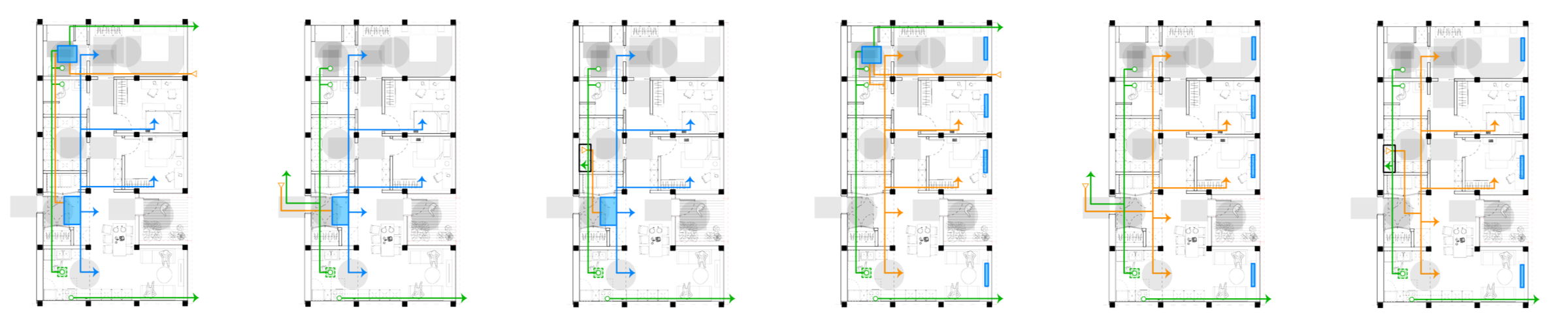
Flexible,
not Prescriptive
This system does not mandate a specific mechanical, electrical, or plumbing approach.
Instead, it provides a robust framework capable of accommodating a range of strategies—whether driven by site conditions, client requirements, energy targets, or regulatory constraints.
The intent is to enable informed choice, not enforce a single solution.
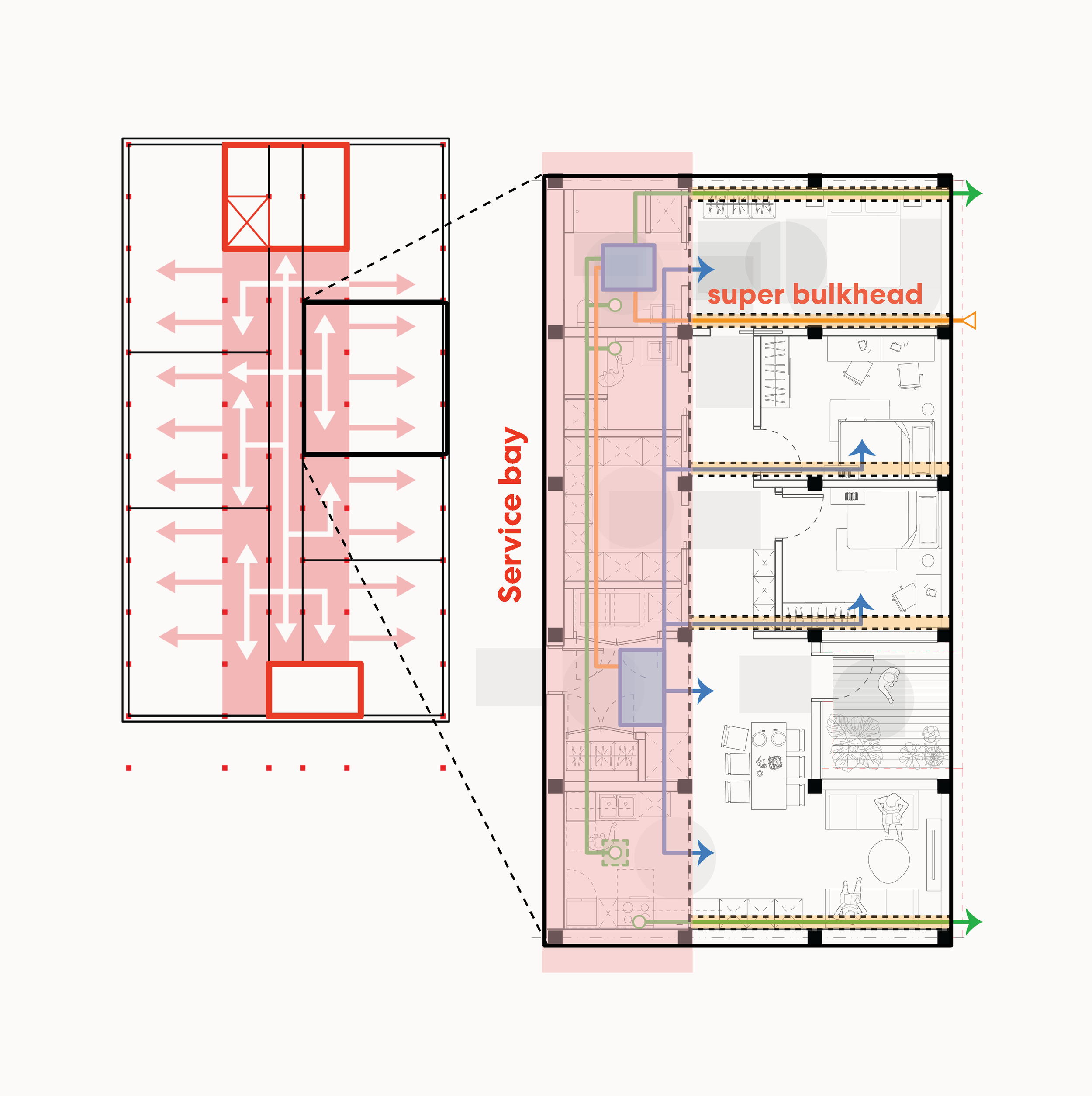
Central Spine
& Service Bay
Centralized service distribution is handled primarily within the corridor zone, where both vertical and horizontal services are consolidated.
Shared systems remain within this spine, minimizing penetrations into dwelling units and establishing a clear, repeatable distribution strategy across the building.
Services enter units only at entry bays, creating deliberate transition from shared infrastructure to unit-level systems.
The first bay of the structural grid is intentionally free of beams, allowing services to run freely within this zone and creating flexibility for adjacent program and layout variations.
Entry bays function as control hubs for unit-level services.
Electrical panels, plumbing manifolds, and related controls are consolidated within this zone, concentrating since
Shared distribution remains within the corridor, with services entering the unit only at this location. Consolidating panels, manifolds, and controls within the first beam-free bay reduces penetrations, simplifies coordination, and preserves flexibility in unit layouts over time.
Entry bays as control hubs
Vertical Services Distribution
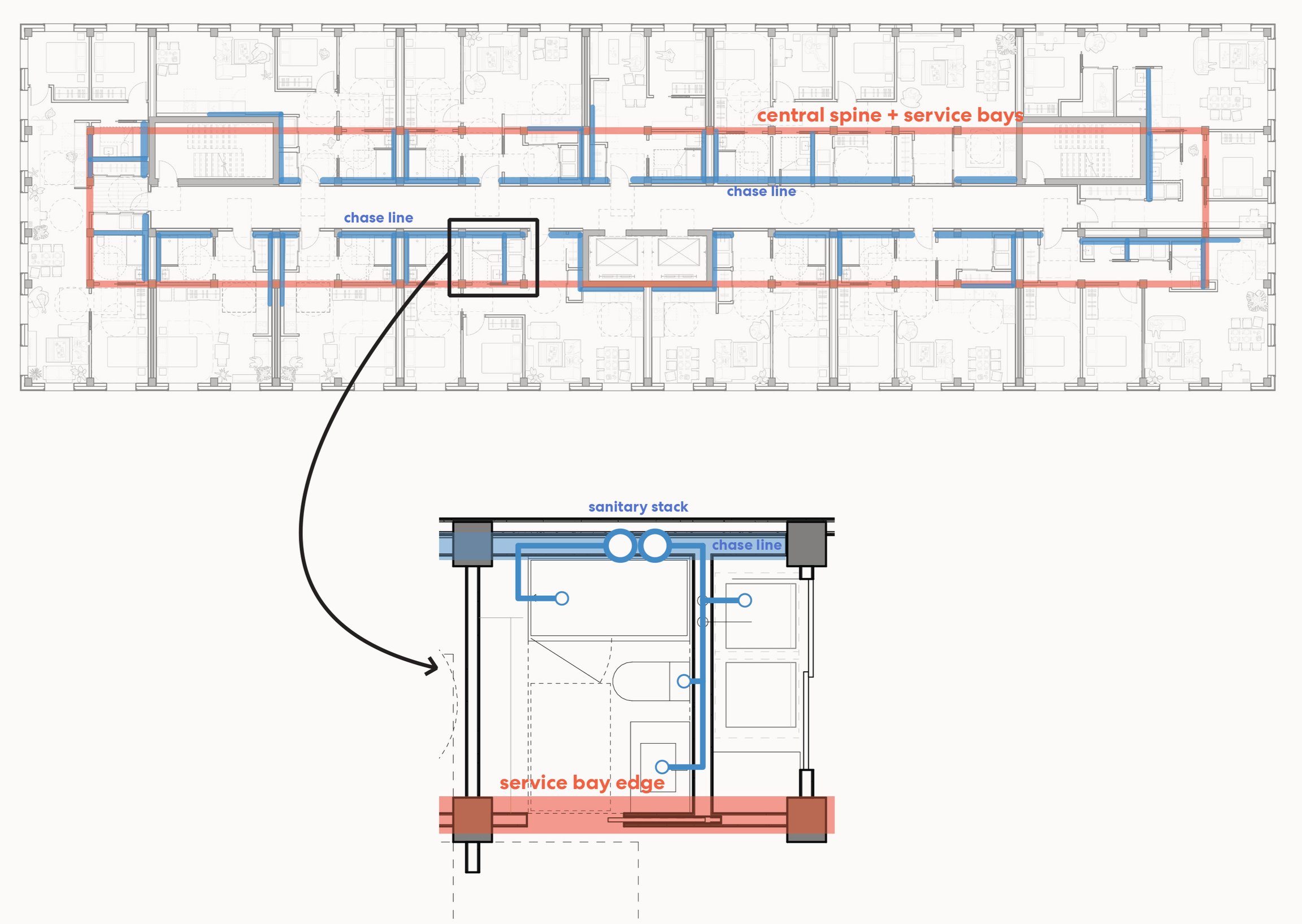
Vertical services are organized within predictable zones aligned to the corridor, allowing plumbing, ventilation, and electrical systems to stack consistently from floor to floor.
This reduces penetrations through primary structural elements and supports repeatable unit layouts across the building.
Vertical risers are housed within chase walls integrated into the corridor wall assembly.
Locating chase walls along the corridor keeps service runs into units short and direct, connecting efficiently to entry bay service hubs. This approach simplifies coordination, preserves interior spatial quality, and enables consistent service stacking without constraining unit planning.